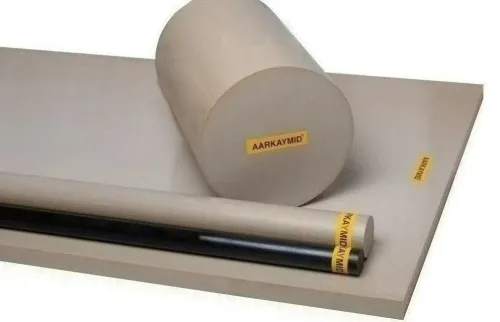

Industrial machinery often relies on rollers, bushes, guides and wear parts that experience repeated movement and loading. Cast nylon can be evaluated where its properties match the machine's operating requirements.
The selection of Cast Nylon Components depends on load, movement, contact pressure, impact, temperature and environmental exposure. These factors can vary significantly between apparently similar components.
When replacing a metallic component, engineers should not assume that reproducing the original dimensions will automatically provide equivalent performance. Differences in material behaviour can influence support, clearances, contact area and deformation.
Moisture exposure is another consideration because nylon's dimensional behaviour can change under different environmental conditions. This can become significant in components designed around controlled clearances.
For maintenance and engineering teams in Pune, the failure history of the existing part can provide useful information. Excessive wear, deformation, impact damage or dimensional changes can indicate which properties the replacement needs to address.
Cast nylon may be suitable for selected mechanical duties, while applications involving demanding temperatures or aggressive chemical environments may warrant comparison with alternative polymers.
A better replacement decision begins with understanding why the existing component is failing rather than simply finding a material with similar dimensions.
For machinery component requirements in Pune, provide the existing part details and service conditions to Classic Polymers & Resins for a practical material assessment.