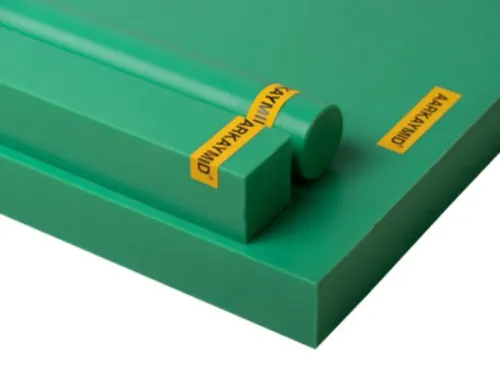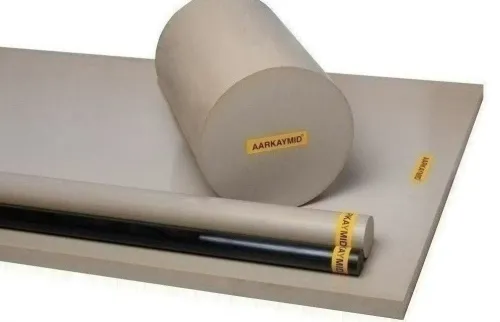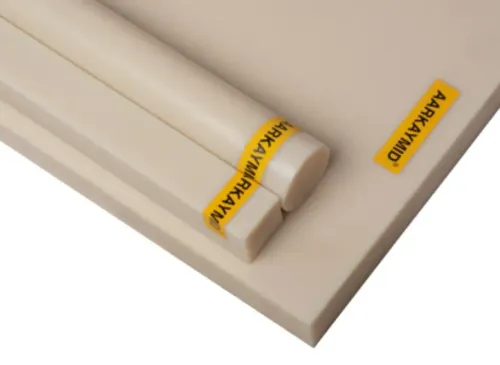

Glass fibres can make a cast nylon plate stiffer, more stable under load and more resistant to heat-related deformation, but they also reduce toughness and complicate machining. By the end, you will know how to compare reinforcement levels, account for moisture and temperature, choose a material for the application, and specify a machining route without relying on unsupported cutting data.
Key takeaways
- Match glass content to stiffness, expansion and machining requirements.
- Allow for moisture and temperature before setting final machining dimensions.
- Use unfilled nylon for lower friction when stiffness is not critical.
- Specify glass percentage, tolerances, conditioning and finish-machining allowance.
What glass reinforcement changes inside a cast nylon plate
Glass fibres turn the PA6 matrix from a relatively ductile plastic into a stiffer, more load-retaining composite. A glass filled polyamide grade commonly contains about 15%, 30% or 33% glass by weight; the percentage changes stiffness, thermal expansion, moisture response and machining behaviour, so “glass filled” alone is not a complete specification.
| Property | Unfilled cast PA6 | Glass-filled cast PA6 |
|---|---|---|
| Stiffness and deflection | More deflection under load | Higher modulus, less deflection |
| Creep at load | Greater permanent movement | Better load retention, especially when warm |
| Heat-deflection temperature | Lower | Higher |
| Elongation and impact toughness | More ductile and forgiving | Lower; notches and shock loads matter more |
| Thermal expansion | Higher | Lower, but direction-dependent |
| Tool wear | Easier on cutting tools | Glass fibres are abrasive and increase tool wear |
These glass filled polyamide benefits matter when a machined bearing housing, guide, roller, wear strip or spacer must hold its shape under pressure and temperature. The higher modulus reduces boring-bar deflection and part flexing in service; lower creep helps maintain clearances around bolted joints and supported shafts.
Glass reinforcement is not a universal upgrade. It can make sharp internal corners, drilled holes and thin edges more crack-sensitive, while fibre distribution can produce different properties parallel and transverse to the casting or plate direction.
Treat a cast nylon plate in glass filled polyamide as direction-sensitive unless supplier data or specimens prove otherwise, and use generous radii where impact dominates.
How moisture and temperature affect dimensions and load retention
Do not set final machining tolerances from a dry, room-temperature drawing alone. A glass filled nylon plate remains hygroscopic, and its thermal expansion can differ parallel and transverse to the glass-fibre direction. The key glass filled polyamide benefits are stiffness and load retention, not dimensional immunity.
1. Identify the grade before calculating movement. Record the glass content, such as 15%, 30% or 33% by weight, plate thickness and fibre-direction data. A generic PA6 datasheet cannot predict the response of your glass filled polyamide.
2. Define the moisture condition for inspection and service. Compare dry-as-moulded, conditioned and immersed values separately; absorbed water plasticises the nylon, increasing toughness while reducing modulus, strength and dimensional stability. Machine and inspect the part after it reaches the specified conditioning state.
3. Calculate thermal movement across the complete service range using ΔL = αLΔT. Use the supplier’s coefficient of thermal expansion for each direction, because glass alignment can make movement anisotropic. A 500 mm feature with a small coefficient still moves enough to consume a tight fit when temperature changes are large.
4. Check load at the highest operating temperature, not only at 23°C. Elevated temperature reduces stiffness and increases creep, even though reinforcement improves retention compared with unfilled nylon. Set clearance, interference and structural tolerances from conditioned dimensions at the actual temperature and sustained load.
Ask for longitudinal and transverse data, conditioning details, and ISO or ASTM test conditions. Without them, a precise tolerance is only a precise assumption.
Choosing the right material for bearings, guides and structural parts
Choose glass filled nylon over unfilled nylon when a guide, spacer or structural plate must resist deflection and creep under sustained load, especially at elevated temperature. A cast nylon plate made from glass filled polyamide is less forgiving of impact, so do not select it for shock-loaded parts without checking toughness.
| Option | Choose glass filled nylon when | Choose the alternative when |
|---|---|---|
| Unfilled cast Nylon 6 | You need greater stiffness, compressive strength and load retention | Impact toughness, simpler machining or lower material cost matters more |
| Oil- or MoS2-filled nylon | You need structural stiffness alongside some self-lubricating behaviour | The part is primarily a bearing and low friction matters more than rigidity |
| Acetal | You need higher stiffness and lower creep under load | Tight wet-service dimensions, low friction and easier precision machining dominate |
| UHMW-PE | The guide needs stiffness and better dimensional stability than polyethylene provides | Extreme impact resistance, chemical resistance or very low friction is the priority |
| PTFE | The part must deliver exceptionally low friction or chemical resistance | High load, wear resistance and thread or edge strength matter |
| Aluminium | You need a rigid, temperature-resistant structural member without polymer creep | Quiet running, electrical insulation, corrosion resistance and lower weight matter |
A glass filled nylon plate is rarely the automatic choice for a bearing: exposed fibres can increase counterface wear, and oil-filled or MoS2-filled grades often run better dry. For highly loaded guides or rollers, compare pressure, speed, moisture and mating-surface data rather than relying on the phrase cast nylon plate.
Also verify glass percentage and longitudinal and transverse properties; a glass filled nylon plate is not automatically isotropic.
A machining decision framework for reinforced nylon parts
Plan reinforced nylon machining around heat control and support, not around aluminium cutting habits. A glass filled nylon plate transfers heat poorly, and its abrasive fibres punish dull tools; rubbing then causes melting, fibre pull-out and a fuzzy edge.
- Drilling: Clamp the plate against a sacrificial backing board. Use a sharp carbide drill, clear chips with pecking, reduce thrust before breakthrough and support the exit to prevent breakout. Add countersinks with a sharp tool and a light cut.
- Milling: Use rigid carbide cutters and sharp edges with enough chip load to cut rather than rub. Take several moderate passes, avoid dwell at corners and use air to clear chips; a hot, packed flute can smear the polyamide.
- Turning: Support thin work securely and keep the tool sharp. Use a positive cutting geometry, continuous feed and a final light pass; stopping the tool against the surface creates heat and torn fibres.
- Sawing: Choose a sharp carbide-tipped blade, clamp close to the cut and let the blade clear chips. Slow the feed if the kerf begins melting, but do not force a dull blade through the glass filled nylon plate.
- Deburring: Scrape or lightly chamfer edges with a sharp hand tool. Avoid aggressive sanding, grinding or repeated passes that round edges while heating the surface.
- Tapped holes: Chamfer the entry, tap with a sharp tool and clear chips frequently. Provide generous thread engagement; use a metal insert for heavily loaded or repeatedly assembled threads, and radius nearby corners to limit crack initiation.
What to specify before buying and finish-machining the plate
Specify the exact polyamide family, nominal glass content and plate thickness. “Cast nylon plate glass filled polyamide” is not a complete material description: 15%, 30% and 33% glass grades machine and retain dimensions differently. Name the colour, additives, manufacturing route and required flatness, thickness and finished-part tolerances.
- State the conditioning state at delivery and before final machining: dry, as-supplied, or moisture-conditioned. Record the temperature and relative humidity used for dimensional inspection, then rough-machine, allow the plate to stabilise, and finish-machine critical surfaces.
- Ask for longitudinal and transverse data, or confirm the supplier’s fibre-orientation convention. Do not assume a cast plate is isotropic; direction affects expansion, shrinkage, stiffness and hole position.
- Define the inspection plan: plate thickness and flatness, visual defects, dimensions at a stated temperature, and samples or certificates tied to the production lot.
- Request data based on named ISO or ASTM tests, not a generic PA6 datasheet. Obtain the grade datasheet, certificate of analysis, lot or batch traceability, conditioning method, glass percentage and dimensional inspection report.
| Purchase detail | What it controls | Evidence to request |
|---|---|---|
| Grade and glass content | Stiffness, creep and machinability | Grade datasheet and lot certificate |
| Conditioning state | Moisture-related size and strength | Conditioning record |
| Direction | Anisotropic expansion and load capacity | Longitudinal/transverse data |
| Tolerances | Finish-machining allowance | Inspection report |
Classic Polymers & Resins can help when the purchasing specification must distinguish a glass-filled grade from ordinary cast PA6, but your drawing still needs the stated direction, conditioning and inspection basis.
Use sharp, rigid tooling for reinforced nylon machining, and leave enough stock to remove fibre-disturbed or heat-affected material during the finishing pass.
Related product
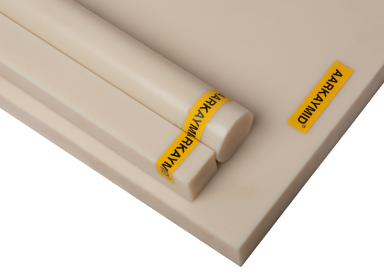 | Polyamide Glass Filled Cast Polyamide 6 (Cast Nylon 6 or PA 6) is one of the most versatile thermoplastics. View product → |
Frequently asked questions
What does glass reinforcement change inside a cast nylon plate?
Glass fibres increase stiffness and load retention while changing thermal expansion, moisture response and machining behaviour. Specify the glass percentage instead of ordering only “glass filled” nylon.
How do moisture and temperature affect glass filled nylon plate dimensions?
Polyamide absorbs moisture, while temperature changes cause expansion. Account for the plate’s service environment, conditioning state and operating temperature before fixing dimensions or tolerances.
How do you choose glass filled polyamide for bearings, guides and structural parts?
Choose based on stiffness, load, friction, wear, dimensional stability and mating-surface requirements. Unfilled nylon suits applications prioritising toughness and lower friction; reinforced grades suit higher stiffness and load retention.
What should you specify before machining a reinforced nylon plate?
State the PA6 grade, glass content, plate thickness, conditioning state, dimensional tolerances, machining allowance, surface finish and service temperature.