
“XLU” alone does not identify a controlled international material grade, so a request for XLU tube can leave room for substitutions in resin, process route, colour, batch or dimensions. By the end, you will have a specification, purchase-order clause and receiving check that keep one approved material moving from raw-material batch to finished tube.
Key takeaways
- Define whether consistency covers polymer, process, colour, batch, or dimensions.
- State tube material, dimensions, tolerances, and manufacturing route in writing.
- Request lot-specific certificates and traceability before accepting the shipment.
- Add no-substitution and segregation clauses to the purchase order.
Define exactly what “without mixing” means before requesting a quote
“Without mixing” must name the consistency you need: one complete commercial grade, one base polymer, one casting or extrusion route, one colour and additive package, one production batch, or one dimensional specification. XLU alone is not a complete internationally controlled designation.
Give the polyamide XLU grade supplier these details:
- Manufacturer’s full grade code and datasheet
- Base polymer: PA 6, PA 66, PA 11 or PA 12
- Cast or extruded process route
- Reinforcement or filler
- Colour, lubricant and release package
- ISO 1874 designation, where applicable
- Required batch and dimensional specification
Do not accept “single grade XLU tube” as a material identity. Require a written equivalence statement before considering any alternative.
| Material description | What you must distinguish |
|---|---|
| Cast PA 6 XLU | Manufacturer’s grade code, casting route and datasheet |
| Standard cast nylon | Not equivalent without written manufacturer confirmation |
| Extruded PA 6 | Different route, stresses and dimensional behaviour |
| PA 66, PA 612 or PA 12 | Different polymer families and properties |
Compare the same details across the quotation, tube label, certificate of conformity and packing list. Any mismatch requires quarantine, not assumption. Similar XLU wording can hide different moisture uptake, modulus, wear, shrinkage and machinability, so request the manufacturer’s datasheet and written equivalence statement before approval.
Write the tube specification so the supplier cannot choose the process or size
Nominal OD and ID are not enough for an xlu engineering tube. Specify the manufacturing route because cast, extruded and machined-from-stock tubes differ in wall uniformity, internal stress, crystallinity, machining allowance and dimensional stability.
| Process | Use this wording | Why it matters |
|---|---|---|
| Cast | “Cast PA 6 XLU, exact manufacturer grade code: ___” | Casting route affects shrinkage and crystallinity |
| Extruded | “Extruded polyamide XLU, exact grade code: ___” | Extrusion produces different stress and tolerances |
| Machined stock | “Polyamide XLU stock shapes for later machining” | Oversize stock tolerances are not finished-tube tolerances |
Send this purchase-request template: “Supply [exact XLU grade code], [cast/extruded/machined-from-stock], finished OD _, ID _, wall _, length _; OD tolerance _, ID tolerance _, wall tolerance _; ovality _; concentricity or eccentricity _; straightness _; end squareness _; surface condition _; colour _; quantity _; allowable joints: _; moisture condition: as supplied/dried/conditioned; dimensions apply [as supplied/after drying/after conditioning].
Finished tube or stock: _. Minimum wall remaining after machining: ___.”
For fluid or gas service, add fluid, concentration, temperature and exposure duration, working pressure, design life and safety factor. Tensile strength or hardness alone does not make a tube pressure-rated; require a wall calculation and hydrostatic or burst-test basis. A maximum temperature is not a continuous-use rating: state temperature with load, moisture, chemicals and time.
Demand lot-specific evidence from the polyamide XLU grade supplier
Demand a lot-specific evidence pack from the polyamide XLU grade supplier before accepting any tube bundle. “COC supplied” does not prove that two or three materials are the same.
1. Require the complete grade designation, manufacturer or compounder, production batch number, manufacturing date, certificate of analysis, material certificate, certificate of conformity and stated test methods. The supplier must provide a traceability statement linking each tube bundle to its raw-material batch.
2. Require values with test conditions: ISO 527 for tensile strength, ISO 178 for flexural properties, ISO 1183 for density and ISO 62 for water absorption where those properties affect your decision. The report must identify specimens as dry, as supplied or conditioned.
Moisture changes polyamide dimensions and mechanical properties, so an unqualified value is not a reliable comparison.
3. Evaluate Classic Polymers & Resins or another supplier using a production sample from one lot. Test the critical characteristics—dimensions, moisture state, mechanical properties and application-specific wear, chemical or pressure performance—then freeze the approved grade code and change-control process.
4. Require written notice before any change to resin source, additive package, colourant, manufacturing route or tooling. Do not accept “equivalent” material without documented requalification.
For a single grade XLU tube, approve one production lot or separately identified lots, record the tested batch, and make the supplier repeat that identity on the certificate and packing list.
Related product
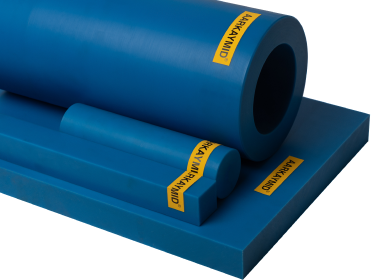 | Polyamide XLU Grade Cast Polyamide 6 (Cast Nylon 6 or PA 6) is one of the most versatile thermoplastics. View product → |
Put the no-substitution and segregation rules on the purchase order
State the controls directly on the purchase order, not in an informal email:
1. “Supply only the approved chemistry, process route, colour, reinforcement level, additive package, manufacturer and supplier identified below. No substitution is permitted unless the buyer approves documented requalification in writing. Do not supply ‘equivalent’ material.”
2. “For a single grade xlu tube, supply the exact approved grade code, one production batch, or separately identified lots approved in advance. Use one grade code per pallet or container. Mark every bundle legibly, provide sealed packaging, and include no mixed remnants. Partial quantities from different batches require separate labels and prior buyer approval.”
3. “The packing list must repeat the grade, colour, batch, dimensions, quantity and length for every bundle. Confirm that picking, cutting, packing and dispatch records preserve tube-to-batch traceability.”
4. “If the requested batch cannot be supplied, notify the buyer before dispatch. Do not select another grade, colour, route or supplier without written approval.” Apply the same wording to an xlu engineering tube order, even when several grades sit in stock; a shared PA family or similar label does not make them interchangeable.
Inspect the delivery without mistaking appearance for material proof
On receipt, treat every bundle as unidentified until its records agree. Compare tube markings, labels, certificates of analysis or conformity, and packing-list entries; photograph each bundle before opening it. Record the exact grade and batch number, then quarantine any piece with conflicting or missing identification.
- Measure OD, ID, wall thickness, ovality and length against the purchase order.
- Inspect colour uniformity, surface condition, joints and end squareness.
- Record the moisture condition used for acceptance: as supplied, dried or conditioned.
- Keep measurements and photographs linked to each bundle and batch.
These checks screen the shipment; they do not prove polymer identity.
| Route | What it changes | Receiving concern |
|---|---|---|
| Cast tube | Casting history, crystallinity and machining allowance | Dimensions can move during conditioning or machining |
| Extruded tube | Extrusion stresses and wall uniformity | Do not treat it as cast material |
| Machined hollow stock | Stock-shape allowance and released internal stress | Final tolerances depend on the machining plan |
Polyamide XLU for engineering plastic tube, an xlu engineering tube, and polyamide xlu stock shapes are not interchangeable descriptions. If documents conflict, request FTIR for polymer identification, DSC for melting and crystallisation behaviour, density testing to ISO 1183, moisture testing, and application-specific mechanical, wear, chemical or pressure tests.
For tight dimensions, request a rough-machining, conditioning and final-pass plan. Do not machine unconditioned stock directly to size; moisture changes and released stress can shift the finished OD and ID.
Frequently asked questions
What does “without mixing” mean when ordering polyamide XLU tube?
Define whether you require one commercial grade, base polymer, casting or extrusion route, colour and additive package, production batch, or dimensional specification. XLU alone is not a complete internationally controlled designation.
What should a polyamide XLU tube specification include?
State the material designation, manufacturing route, tube dimensions, wall-thickness tolerance, length, colour, additives, surface requirements, packaging, and acceptance documents. This prevents the supplier from selecting the process or size.
What evidence should you request from a polyamide XLU grade supplier?
Request lot-specific documentation showing the supplied grade, batch or heat number, manufacturing route, dimensions, test results, and traceability to the delivery.
How do you prevent substitutions and mixed lots on the purchase order?
Write that substitutions require your written approval, identify the permitted grade and process, require segregation by lot, and demand separate labels and documents for each lot.