
A replacement tube that matches the old part’s nominal size can still fail through leakage, creep, permeation, kinking or an incompatible fitting seal. By comparing the service conditions, material trade-offs, dimensions and connection design, you can select a replacement that works beyond the first pressure test.
Key takeaways
- Start with fluid, temperature, pressure and vacuum duty—not the failed tube’s material.
- Check PTFE pressure, creep, permeability, abrasion and bend-radius limits before specifying it.
- Measure tube dimensions and match the complete fitting, seal and connection arrangement.
- Request traceability, material details, pressure ratings and construction documents from the supplier.
Start with the service conditions, not the old tube’s material
Fluid identity, concentration, temperature, pressure and vacuum duty decide whether a PTFE tube is suitable—not the material used in the failed tube. Add flow rate, gas permeability, abrasion, flexing, vibration, electrical insulation and the required bend radius before you compare materials.
| Service requirement | PTFE tube suitability | Stop and reassess when |
|---|---|---|
| Chemical exposure | Strong resistance across many corrosive fluids | The service involves molten alkali metals or fluorinating agents |
| Temperature | Roughly −200 to +260 °C continuous service, grade and duty dependent | You are using a short-exposure maximum as the continuous rating |
| Pressure or vacuum | Works when wall thickness, support and temperature match the rating | The tube is unsupported, cycled, tightly bent or treated like reinforced hose |
| Permeability | Low-friction, chemically resistant conveyance | Gas retention, vacuum integrity or oxygen purity demands documented permeation data |
| Mechanical movement | Flexible and electrically insulating | Repeated flexing, vibration or fitting pull-out demands reinforcement |
Plain PTFE creeps under load, loses pressure capacity as temperature rises and can kink or fatigue. A braided PTFE hose is a different construction; do not substitute it for plain tube by dimensions alone.
Match bore tolerance, concentricity, wall thickness, fitting geometry and seal material. PTFE also resists ordinary adhesive bonding, so specify mechanical retention, surface treatment or another fluoropolymer when bonding is part of the assembly.
ASTM D3295 addresses PTFE tubing, but it does not prove suitability for medical, food-contact, oxygen, clean-service, pressure or vacuum use. Request grade-specific ratings, permeation data and declarations for those duties.
How PTFE compares with PVDF, PEEK, plastics, rubber, metal and glass
A ptfe tube is usually the best choice for chemical inertness and low friction, not stiffness or load-bearing. Choose the alternative when the tube must hold its shape, resist abrasion, retain gas, flex repeatedly, or provide a visible flow path.
| Material | Better than PTFE for | Trade-off |
|---|---|---|
| PVDF | Higher stiffness, lower gas permeability and clearer visibility | Lower maximum temperature and narrower chemical resistance |
| PEEK | Structural strength, dimensional stability, wear and pressure resistance | Higher cost and less resistance to concentrated acids and bases |
| Nylon, POM or ETFE | Rigidity, machining and abrasion resistance | Reduced temperature or chemical capability; nylon absorbs moisture |
| Polyurethane or rubber | Flexibility, vibration isolation and repeated bending | Higher permeation, swelling and lower temperature stability |
| Stainless steel | Pressure, structural strength, low permeability and vacuum retention | No electrical insulation, higher weight and possible corrosion |
| Glass | Visibility, dimensional stability and chemical purity | Brittle, rigid and vulnerable to impact and thermal shock |
Virgin PTFE can creep under sustained pressure, so a tight fitting or bearing guide may lose its intended dimensions. Filled PTFE, PEEK or POM suits that duty better; confirm the filler’s chemical compatibility before choosing it.
Use PVDF, PEEK or metal when helium, hydrogen, oxygen, refrigerant or solvent-vapour retention matters. Select PFA or FEP when transparency or heat sealing matters, but obtain the grade-specific continuous temperature limit rather than relying on a short exposure rating.
For bonded assemblies, avoid assuming ordinary adhesive will hold PTFE; use mechanical retention, surface treatment or another polymer.
Account for PTFE’s pressure, temperature, creep and permeability limits
A tube rated to 260 °C is not automatically safe at 260 °C under pressure. PTFE’s useful continuous-service range is roughly −200 to +260 °C, but allowable duty depends on grade, wall thickness, pressure, support and exposure time. Short exposure temperature is not continuous-service temperature; obtain grade-specific pressure-temperature data.
Plain PTFE has no reinforcement layer. Treating an industrial PTFE replacement tube like reinforced hose creates predictable failures:
- Pressure capability falls as temperature rises, while creep, or cold flow, enlarges the bore, thins the wall and loosens compression fittings.
- Tight bends, unsupported spans, vibration and cyclic flexing can kink the tube, fatigue it or pull it out of its fitting.
- Under vacuum, external collapse or ovalisation can restrict flow; verify the vacuum rating at the actual temperature and bend condition.
- PTFE’s gas and organic-vapour permeability exceeds that of metal and some engineering thermoplastics. A pressure test can pass while helium, hydrogen, oxygen, refrigerant or solvent vapour escapes over time.
- Adhesives rarely bond ordinary PTFE. Use mechanical retention, qualified etching or a different fluoropolymer when the assembly depends on bonding.
For high-pressure unsupported service, repeated movement or strict gas retention, choose reinforced construction or a stiffer material rather than plain PTFE. ASTM D3295 identifies tubing requirements, but does not prove suitability for pressure, vacuum, oxygen, food, medical or clean service; request separate evidence.
Measure the replacement tube and match the complete connection
A replacement fails when the tube fits the drawing but not the connection. For an industrial ptfe replacement tube, record finished length, outside diameter, inside diameter or bore, wall thickness, bore tolerance, concentricity, ovality and cut-end squareness. Specify continuous temperature, pressure, vacuum, temperature cycling, gas permeability and electrical-insulation requirements.
| Connection detail | Verify | Why mismatch fails |
|---|---|---|
| Tube geometry | OD, bore, wall, tolerances and minimum straight length | A loose bore changes flow; excess wall prevents ferrule engagement |
| Bend path | Minimum bend radius, bend angle, unsupported span and cyclic movement | A tight bend kinks plain PTFE and can pull the fitting out |
| End connection | Compression, flare, barb, threaded adapter, insertion depth and ferrule profile | The wrong geometry leaks even when the tube diameter matches |
| Construction | Plain tube, braided hose, lined pipe or machined sleeve | Reinforcement changes pressure capacity, flexibility and end dimensions |
| Sealing | Seal material, groove size and compression | PTFE creep can relax sealing stress under sustained load |
Measure the installed route, including movement at full travel, and compare it with the supplier’s dimensional tolerance rather than a nominal size alone. Check whether the tube enters a metal ferrule, a flare cone or a barbed fitting; these details determine the required bore and wall.
Ask for compatibility data for every seal touching the fluid. FKM, EPDM, FFKM, silicone and PTFE-encapsulated seals have different temperature and chemical limits. If the assembly depends on adhesive bonding, stop: untreated PTFE resists ordinary adhesives, so use mechanical retention, a specified etched surface or a different fluoropolymer.
Qualify the supplier with documents and construction details
Searching for a ptfe tubing supplier in ludhiana is only the starting point. Approve the replacement after the supplier proves its material, construction and performance against your drawing and service conditions.
1. Request the resin or compound grade, virgin or filled formulation, colour, and any ASTM D3295 type or class claimed. A material certificate should identify the manufacturer’s lot number, not merely say “PTFE.”
2. Request a dimensional report for outside diameter, bore, wall thickness, concentricity, ovality and tolerances. Confirm the minimum bend radius, cut length and the exact flare, ferrule or fitting geometry.
3. Confirm that the item is plain extruded tube, braided PTFE hose or PTFE-lined pipe. Plain tube has no reinforcement; substituting braided hose changes flexibility, pressure behaviour and end connections.
4. Obtain pressure and vacuum ratings with the test method, temperature derating curve and temperature-cycle limits. Ask how the supplier checked leakage, burst pressure and fitting pull-out.
5. Require a certificate of conformity, batch traceability and inspection record linking the shipment to the quoted grade. Add permeability, electrical, clean-service, food-contact or oxygen declarations when your application needs them.
Ask Classic Polymers & Resins for these records in writing, just as you would from any candidate supplier. A datasheet alone does not prove that the delivered tube matches the approved construction.
Related product
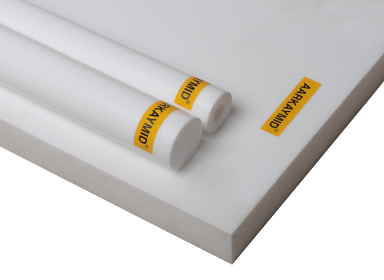 | PTFE PTFE material (polytetrafluoroethylene commonly referred to as Teflon) is a highly dense material, semi crystalline in nature, renowned for its... |
Frequently asked questions
What service conditions determine whether PTFE tube is suitable?
Check fluid identity and concentration, temperature, pressure, vacuum duty, flow rate, gas permeability, abrasion, flexing, vibration, electrical insulation and required bend radius.
How does PTFE compare with PVDF, PEEK, rubber, metal and glass tubing?
PTFE offers broad chemical resistance and electrical insulation, while PVDF, PEEK, rubber, metal and glass differ in temperature capability, pressure strength, flexibility, permeability, abrasion resistance and chemical compatibility.
What PTFE tube limitations must you check before replacement?
Verify pressure and vacuum ratings at the operating temperature, then assess creep, gas permeability, abrasion, flexing and minimum bend radius.
How do you measure and specify an industrial PTFE replacement tube?
Record inside diameter, outside diameter, wall thickness, length, bend radius, end style, fittings, seals, connection method and operating conditions.