
A nylon tube can leave production within tolerance and still change size after absorbing moisture, cycling through temperature, or taking a sustained load. By the end, you will be able to define the dimensional condition, compare candidate materials, set realistic tolerances, and procure tubing with evidence that matches its service environment.
Key takeaways
- Define allowable diameter, wall-thickness and ovality changes before ordering.
- Treat moisture exposure as a dimensional variable, not only a material property.
- Compare PA12, PA66 and competing materials against your temperature and fluid limits.
- Request inspection records, conditioning details and service-test evidence before approval.
What dimensional stability means in a nylon tube
Dimensional stability means a nylon tube keeps its specified geometry through machining, moisture exposure and temperature changes. Control the dimensions that affect fit and flow:
- Outside diameter and inside diameter
- Wall thickness, including local thin areas
- Roundness or ovality
- Concentricity between bore and outside diameter
- Cut length after machining
Buyers must also identify the dimensional reference state:
- Dry-as-moulded: the low-moisture condition immediately after manufacture or drying.
- Laboratory-conditioned: dimensions measured after exposure to a specified laboratory temperature, humidity and conditioning time.
- Equilibrium-conditioned: dimensions measured after the tube reaches moisture equilibrium with the intended service environment.
Nylon absorbs water from air and liquids. That absorbed moisture increases mass and dimensions, while reducing stiffness, yield strength and electrical insulation resistance; it also increases elongation and can change dielectric behaviour. Temperature cycling adds thermal expansion, contraction and possible residual-stress movement.
A tube dimensionally stable for nylon tube applications therefore needs a stated moisture and temperature basis.
ISO 62 and ASTM D570 measure water absorption, usually as mass gain under defined immersion or conditioning conditions. They do not, by themselves, predict the dimensional change of a finished tube, whose geometry, wall thickness, machining history and conditioning rate also matter.
“Stable nylon components” means stable against named humidity, temperature and exposure conditions—not every humidity or temperature cycle.
Yellow nylon tube applications and their operating limits
Yellow nylon tube applications depend on the service conditions, not the colour:
| Application | Suitable service condition |
|---|---|
| Guide bushes and bearing liners | Intermittent sliding contact with controlled load, speed and lubrication |
| Rollers and wear strips | Controlled load and sliding speed; verify heat from friction |
| Spacers and insulation sleeves | Electrical and mechanical properties remain within the design range after moisture and temperature exposure |
| Pneumatic or low-pressure fluid routing | Pressure rating includes tube size, temperature, service life, moisture, pulsation and fitting system |
| Cable protection | Abrasion, bend radius, unsupported span and crushing loads remain acceptable |
Yellow identifies colour only. It does not prove PA6 or PA12 resin, UV stabilisation, flame retardancy, fuel compatibility or pressure approval. Colourant can change ageing, optical detection and lot-to-lot consistency, so specify an accepted colour range or reference standard and confirm that the coloured formulation retains its required performance.
Put these requirements on the drawing or purchase order:
- PA grade and additive package
- Maximum continuous and intermittent temperature
- Pressure rating with temperature and moisture conditions, plus vacuum suitability
- Unsupported span and permitted creep allowance
- Sliding speed and bearing load
- Exposure limits for oils, solvents, acids and cleaning agents
Check actual chemical formulations and service cycles; “nylon compatible” is not enough. Absorbed moisture can alter fit, stiffness, pressure behaviour and electrical insulation, while temperature cycling can move dimensions beyond the original tolerance.
How nylon compares with PA12, PA66 and competing tube materials
PA12 is chosen when lower moisture uptake and dimensional change matter more than the higher stiffness and strength of PA6 or PA66. A design dimensionally stable for nylon tube applications therefore needs its service condition stated, not just its resin name.
| Material | Moisture, stiffness, friction and wear | Temperature, chemistry, cost and machining |
|---|---|---|
| Yellow cast PA6 | Higher moisture uptake; high stiffness and toughness; moderate friction and wear | Broad engineering range; good oil resistance; medium cost; machines well but residual stress matters |
| Extruded PA6 | Same moisture sensitivity; strong and stiff; moderate wear | Economical continuous lengths; machining is easy, but ovality, wall eccentricity, die-line variation and lot drift can affect fit |
| PA12 | Lower uptake and dimensional change; lower stiffness and strength than PA6/PA66; good toughness and wear | Good chemical resistance; medium-high cost; machines readily |
| PA66 | Highest stiffness and strength among these nylons; moisture changes remain significant | Higher temperature capability; good oils, weaker against strong acids; medium cost; machinable |
| POM (acetal) | Low moisture sensitivity, low friction and good wear; less tough than nylon | Good dimensional control and machinability; moderate chemical and temperature capability; medium cost |
| PTFE | Negligible uptake; extremely low friction; poor stiffness and creep resistance | Exceptional chemical resistance and temperature range; high cost; difficult to machine accurately |
| UHMW-PE | Low stiffness; outstanding abrasion and impact wear | Lower temperature capability; good chemical resistance; low-medium cost; machines easily |
| Metal | No moisture swelling; highest stiffness, pressure and temperature capability | Corrosion, weight and machining cost increase; friction depends on alloy and finish |
Extrusion suits continuous lengths, while machining improves local control at added cost, waste and length limits, with residual-stress distortion risk. Stable nylon components require agreed gauges, conditioning and sampling before quotation.
How to specify and machine a precision nylon tube
Specify a precision nylon tube by function, not nominal OD alone. A drawing must control bore, wall thickness, ovality or roundness, concentricity, straightness and cut length; OD and wall thickness can still hide a restricted bore or a locally thin wall. State whether each dimension applies dry-as-moulded, laboratory-conditioned or equilibrium-conditioned.
- Record nominal OD and bore; OD and ID tolerances; wall thickness; ovality or roundness; concentricity; straightness; cut length; surface finish; colour; grade designation; and the conditioning state used for measurement.
- For push-in or compression fittings, confirm actual OD, hardness, surface finish and ovality. Specify a square, burr-free cut: a damaged or angled end can leak even when average OD is correct.
- Machine oversize, condition the tube, then finish to size when moisture movement or residual stress threatens the final tolerance. Support the bore and use low, distributed clamping force; gripping the outside can cause distortion, end movement and delayed dimensional change.
| Specification choice | What it controls | What goes wrong if omitted |
|---|---|---|
| OD and ID | Fit and flow passage | Restricted bore behind an acceptable OD |
| Wall thickness and concentricity | Pressure wall and local strength | Thin sector hidden by average thickness |
| Conditioning and measurement | Repeatable dimensional reference | Metal-style tolerance passes inspection, then moves with humidity |
Control the environment, measurement method and conditioning time before quoting tight tolerances. Extruded tube needs checks for die-line variation, ovality and lot drift; machining improves local control but adds waste and residual-stress risk.
The nylon tube procurement checklist for verified service performance
Issue the latest drawing revision with a service profile before requesting prices. Define the precision nylon tube’s media, pressure, temperature, vacuum, duty cycle, unsupported length, storage environment, critical dimensions and conditioning state.
1. Request the resin and additive designation, material batch or lot number, certificate of conformity, test certificates and every approval claimed. Require the supplier to state moisture condition at inspection, post-extrusion conditioning or annealing, manufacture-to-inspection time and storage history.
2. Agree the incoming-inspection method before shipment. Name calibrated bore gauges, air gauges, micrometers, optical measurement or roundness equipment; then set the sample size, measurement locations and acceptance criteria for OD, ID, wall thickness, roundness, concentricity and cut length.
3. Specify packaging that caps or protects cut ends, prevents crushing and limits humidity during storage and transit. Record the seal condition and storage exposure when the nylon tube procurement lot arrives.
4. For vehicle work, identify DIN 73378 as a relevant tube requirement, then check separate requirements for industrial, pneumatic, laboratory or chemical service. Do not treat vehicle compliance as universal approval.
5. Ask Classic Polymers & Resins, or any alternative supplier, for grade-specific pressure-temperature data, chemical compatibility results, dimensional reports and a production sample. Reject a colour name or room-temperature pressure figure as evidence; yellow nylon tube applications require verified resin, additives and performance.
6. Validate the actual oil, solvent, acid, base or cleaning cycle before release, including concentration, temperature, exposure time and moisture condition.
Related products
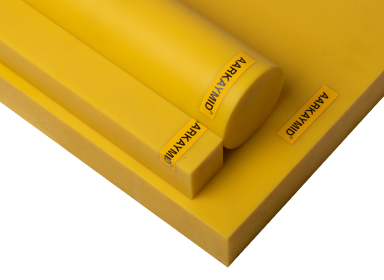 | Polyamide Yellow Dimensional Stable Polyamide Yellow Dimensional Stable Cast Polyamide 6 (Cast Nylon 6 or PA 6) is one of the most versatile thermoplastics. View product → |
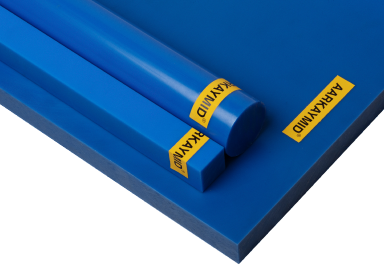 | Polyamide MC Stabilized Grade Cast Polyamide 6 (Cast Nylon 6 or PA 6) is one of the most versatile thermoplastics. View product → |
Frequently asked questions
What does dimensional stability mean in a nylon tube?
It means the tube retains specified diameter, wall thickness, ovality and fit after moisture exposure, machining and temperature changes.
Where are yellow nylon tubes used, and what limits matter?
Yellow nylon tubes suit applications where their colour, mechanical performance and chemical compatibility fit the service conditions. Check temperature, pressure, moisture, fluid exposure, wall thickness and bend radius before selection.
How does nylon compare with PA12, PA66 and other tube materials?
Compare the exact grade by moisture uptake, stiffness, temperature capability, chemical resistance, pressure retention, dimensional change and machining behaviour rather than by the nylon label alone.
What should you specify when buying a precision nylon tube?
Specify polymer grade, colour, inside and outside diameters, wall thickness, tolerances, length, straightness, ovality, surface finish, conditioning state, inspection documents and service conditions.
Related product
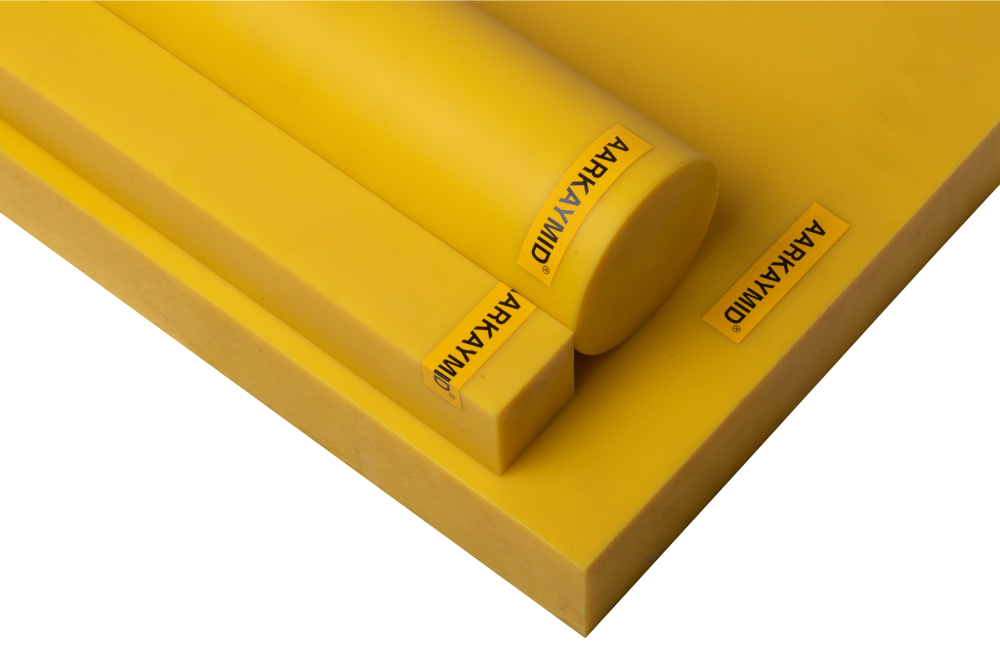 | Polyamide - Dimensionally Stable (Yellow) Polyamide - Dimensionally Stable (Yellow) Cast Polyamide 6 (Cast Nylon 6 or PA 6) is one of the most versatile thermoplastics. View product → |