
“Natural” usually describes an uncoloured, usually unfilled nylon grade, but it does not identify the polymer family, manufacturing route, resin history or additive package by itself. By the end, you will be able to define the material, specify a tube or machined part, compare moisture-conditioned data and request documents without combining values from incompatible nylon grades.
Key takeaways
- Treat “natural” as appearance and filler status, not proof of chemically pure resin.
- Name the polymer family, process route, dimensions, tolerances and test conditions separately.
- Specify tube size by inside diameter, outside diameter, wall thickness and length.
- Confirm the grade on the quotation, product label and certificate before release.
Define natural polyamide before you compare properties
Natural polyamide normally means an uncoloured, usually unfilled grade; it does not certify chemically pure resin. Define it by an explicitly named polymer family, such as cast PA 6, PA 66 or PA 12, plus every declared processing additive. “Natural” describes appearance and often filler status, not the complete composition.
Do not silently include:
- MoS2
- Glass fibre
- Mineral reinforcement
- Pigments
- Special stabilisers
- Liners or coatings
- An undisclosed blend
“Natural” does not prove virgin resin, no-regrind status, or the absence of lubricants, mould-release agents, stabilisers or residual moisture. Specify virgin resin, approved regrind, recycled content or a no-regrind requirement on the order. Density alone cannot prove an unfilled grade because polymer family and reinforcement change density.
| Family | Typical distinction | Specification consequence |
|---|---|---|
| PA 6 | Higher stiffness and temperature capability; greater moisture uptake | State the moisture condition before comparing strength or dimensions |
| PA 66 | Higher stiffness and temperature capability; greater moisture uptake | Do not substitute its data for PA 6 or PA 12 |
| PA 12 | Lower moisture uptake and greater flexibility | Use its own dimensional and mechanical data |
PA 6, PA 66 and PA 12 therefore cannot share one generic “nylon” specification. Establish the family, declared additives and resin status before comparing any performance number.
Keep polymer family, process route and test condition in separate boxes
A quotation or drawing prevents merged specifications only when it names the polymer family, grade and manufacturing route in separate fields.
Write cast PA 6, extruded nylon tube, injection-moulded nylon or machined cast stock—not simply “natural nylon.” Extrusion can introduce orientation, ovality, wall variation and residual stress, so extruded tube is not automatically equivalent to cast or machined material.
- Density, tensile strength, tensile modulus, elongation and compressive strength
- Impact method, hardness, coefficient of friction and wear result
- Melting point or processing range, water absorption method and temperature limits
- Moisture state for every value: dry-as-moulded, conditioned or equilibrium moisture
- Test method and specimen direction where orientation affects the result
2. Reject mixed data. Do not combine tensile strength from PA 6, hardness from PA 66 and wear data from a filled grade. Generic tensile strength cannot establish a pressure rating because wall thickness, temperature, time, moisture, fluid exposure and support condition control tube performance; melting point alone cannot establish a safe continuous-use temperature.
3. Use this comparison grid:
| Material or route | Keep separate because | Record |
|---|---|---|
| Cast PA 6 | Base polymer and cast structure | Grade, dimensions, moisture state |
| PA 66 | Different polymer family and absorption behaviour | Grade and test method |
| PA 12 | Different flexibility and moisture response | Grade and conditioning |
| Filled grade | Reinforcement or lubricant changes properties | Filler type and content |
| Extruded tube | Orientation, ovality and residual stress | Route, wall variation and tolerances |
This keeps each comparison traceable to one material, one route and one test condition.
Write natural nylon order details that identify the actual tube or stock
Put more than “natural nylon” on the purchase order: natural nylon order details must identify the polymer, product form, dimensions, quantity and delivery condition.
1. Name the exact designation, such as PA 6, cast nylon 6, PA 66 or PA 12, and state whether the product is hollow cast, extruded, injection-moulded, or machined from solid stock. Specify natural or off-white colour separately, including acceptable colour variation and whether weld lines, extrusion marks or slight resin-colour variation are acceptable.
2. For tube, state inside diameter, outside diameter and the derived wall thickness, with dimensional tolerances and roundness or ovality limits. Add the required cut length or continuous-length supply, quantity, and whether ends must be sawn, faced or deburred.
3. Define the natural polyamide tube contents as the base polymer plus every declared additive package. Ask whether it is a simple tube, a solid part with a bore, or a construction containing a liner, reinforcement, insert or coating; “natural” must not imply an undisclosed mixture of PA 6, PA 66 and PA 12.
4. For machining stock, state machining allowance, final dimensions and final tolerances. For fluid, pressure or vacuum service, name the fluid and concentration, temperature range, pressure or vacuum, duty cycle and support condition. Specify whether delivery is dry-as-supplied, conditioned or otherwise protected, and record the required batch traceability.
Design for water, heat and movement before choosing a fit
Moisture is a design input, not a footnote. Natural PA 6 absorbs atmospheric water, which acts as a plasticiser: mass and dimensions change, while stiffness, tensile strength, elongation, impact behaviour and electrical properties shift.
Require dry-as-supplied and conditioned values, the conditioning method and a storage or preconditioning instruction. For a tube or machined part, calculate clearance after moisture conditioning, then add thermal expansion and allowance for cast or extrusion shrinkage. Check movement along and across the processing direction; extrusion orientation can make those values differ.
A press fit can loosen or tighten after humidity exposure. A tight bore can close enough to affect a shaft, cable or fluid path. State application temperature, chemical exposure and duty cycle instead of using a room-temperature data-sheet value.
PA 6 and PA 66 suit higher stiffness and temperature demands, but demand tighter moisture control. PA 12 suits lower moisture-related movement and greater flexibility when those advantages outweigh stiffness.
| Material | Main design advantage | Main control point |
|---|---|---|
| PA 6 | Stiffness and temperature capability | Moisture-driven movement and property change |
| PA 66 | Higher stiffness and temperature capability | Greater moisture sensitivity |
| PA 12 | Flexibility and lower moisture-related movement | Lower stiffness than PA 6 or PA 66 |
For pressure, vacuum or fluid service, separate pressure performance from bulk strength. Check wall thickness, temperature, time, moisture, chemical compatibility and support, and state the fluid, concentration, pressure or vacuum and duty cycle.
Verify the grade on the quotation, label and certificate
A receiving check proves the shipment matches the order only when the quotation, label and certificate identify the same material. “Natural” is a colour description, not proof of polymer family, virgin resin or an unfilled formulation.
- Confirm the order and packaging state PA 6, cast nylon 6, PA 66 or PA 12; the form and process route; tube inside and outside dimensions or sheet thickness; length; natural or off-white colour; quantity; and permitted tolerances.
- Check the batch or lot number on the label against the manufacturer’s certificate of conformity. Record any filler declaration, including “unfilled,” and the statement covering virgin resin, approved regrind or recycled content.
- Match the certificate to the applicable test standard and stated moisture condition: dry-as-moulded, conditioned or equilibrium moisture. Reject a certificate that says only “nylon” without a polymer family, moisture condition, test method or lot reference.
- Request a technical data sheet tied to the named grade, a manufacturer’s certificate of conformity and, where the contract requires it, an EN 10204 3.1 inspection certificate.
A requested document is not guaranteed to accompany every shipment. Write each document requirement into the purchase order and confirm availability before buying.
For engineering-plastic stock or machined components, give Classic Polymers & Resins the drawing, service conditions and documentation requirements so the quotation is assessed against a defined PA grade rather than a colour name.
Accept only one polymer family, one grade, one process route, one stated moisture condition and one traceable lot.
Related product
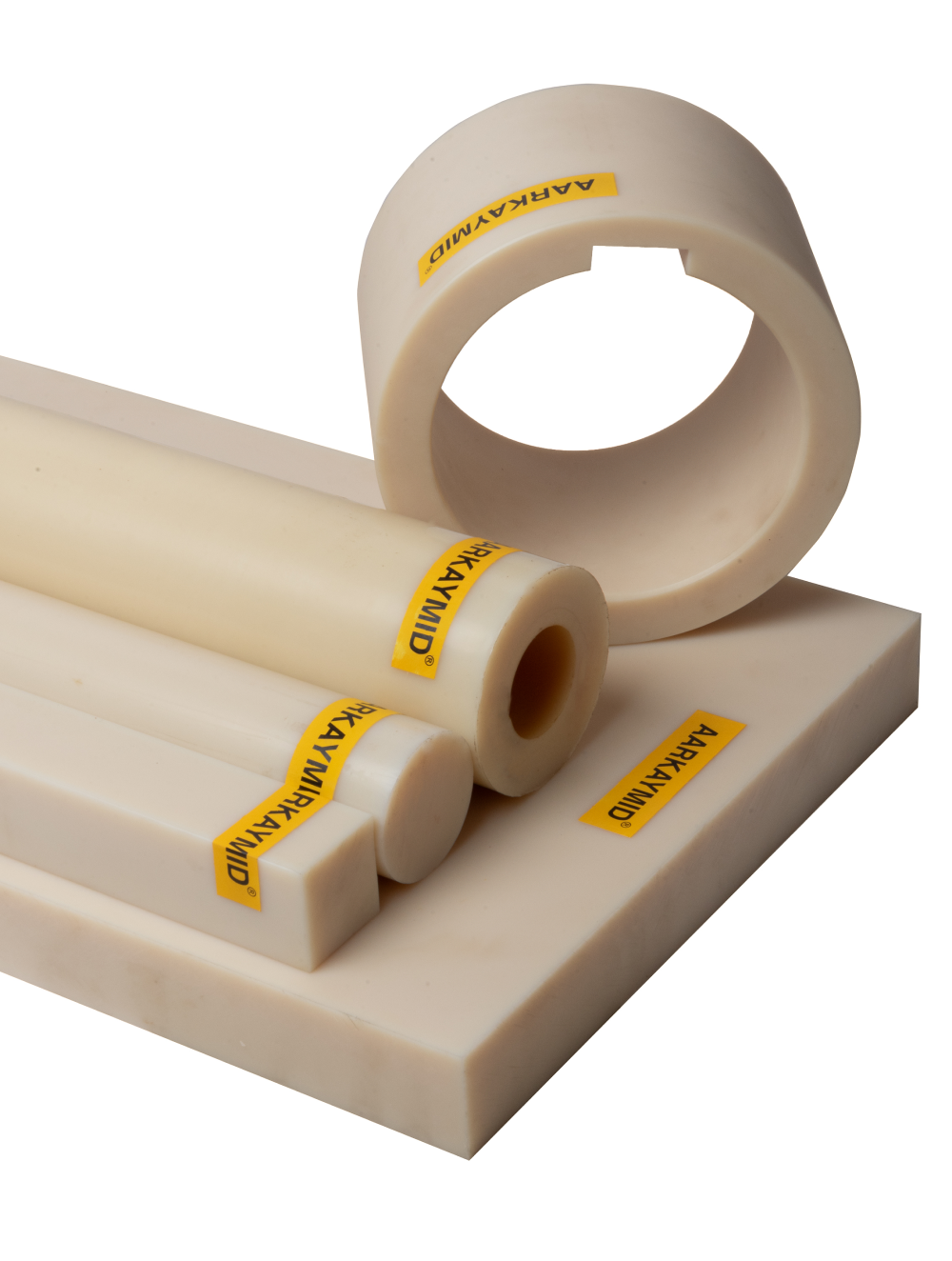 | Polyamide Natural Polyamide - Cast Polyamide Cast Polyamide 6 (Cast Nylon 6 or PA 6) is one of the most versatile thermoplastics. View product → |
Frequently asked questions
What does natural polyamide mean?
Natural polyamide usually means an uncoloured, unfilled grade, but it does not certify chemically pure resin. Specify the named family, such as cast PA 6, PA 66 or PA 12, and list every declared additive.
How should you separate polymer family, process route and test condition?
Record them as separate details: identify the polymer family, state whether the stock is extruded, cast or otherwise processed, and name the test method, temperature, humidity and conditioning used for each property.
What natural nylon order details identify the actual tube or stock?
State the polymer grade, process route, inside diameter, outside diameter, wall thickness, length, dimensional tolerances, colour, quantity and required certificate. Confirm whether dimensions are measured before or after conditioning.
How should you design natural polyamide for water, heat and movement?
Account for moisture absorption, operating temperature, thermal expansion, clearance, load and sliding speed before choosing a fit. A dry interference fit can loosen after water exposure, while excessive interference can cause stress or seizure.
Where should you verify the natural polyamide grade?
Compare the grade designation and composition across the quotation, product label and certificate. Resolve differences before production, especially when the documents omit the polymer family, filler status or process route.