
A sliding component fails when its material, mating surface, load and speed are chosen separately. By the end, you will be able to compare POM Black with common alternatives, calculate the duty factors that matter, specify the correct grade and request evidence before ordering machined parts.
Key takeaways
- Check load, speed, temperature and contamination before choosing POM Black.
- Specify a tribological grade instead of treating black colour as proof of low friction.
- Allow for machining stress, thermal expansion and moisture when setting clearances.
- Ask a Bhopal supplier for grade, tolerance, batch and test documentation.
How POM Black controls friction in moving machine parts
A smooth POM Black surface lowers resistance where a shaft, rail or thrust face slides against the component. Its low moisture uptake helps preserve running clearances through Bhopal’s monsoon humidity, reducing starting drag, stick-slip and operating noise. In clean, moderate-duty assemblies, that dry-sliding behaviour can reduce dependence on external grease.
- Typical applications include bushes, guide rollers, sliding blocks, wear pads, gears, thrust washers, plain bearings, sprockets and wear strips.
The POM Black benefits in Bhopal come from a useful balance of stiffness, wear resistance and dimensional stability, not from colour alone. These are practical reasons to consider POM Black for machine components in Bhopal, but the counterface, pressure, speed, temperature and contamination still decide service life.
The acetal benefits in Bhopal are strongest where nylon’s moisture absorption threatens fit and alignment.
| Option | Friction and wear position | Main trade-off |
|---|---|---|
| POM Black | Balanced stiffness, wear resistance and dry sliding | Grade and counterface data remain essential |
| POM White | Similar base-polymer behaviour | No automatic UV advantage from natural colour |
| Nylon | Tough and widely available | Absorbs more moisture, changing clearances |
| UHMWPE | Very low friction | Lower stiffness and load-support capability |
| PTFE | Lower friction than POM | Higher creep and weaker load capacity |
| PET | Good wear in selected duties | Require grade-specific testing |
| Metal | Higher loads and temperatures | Needs lubrication, finishing and corrosion control |
Match the component to load, speed, temperature and contamination
A bushing that survives a static load can still fail during travel. Decide from the complete motion, not from a catalogue friction number.
1. Record the mating material, shaft or rail finish, contact pressure, sliding speed, duty cycle, lubrication condition, temperature, alignment and clearance. Note contamination: dust, grit, water and process residue can turn a smooth sliding interface into an abrasive or sticking one.
2. Calculate PV loading as pressure multiplied by sliding velocity. A part that runs acceptably at low speed can overheat, soften, wear rapidly or seize during continuous high-speed travel even when the static load is unchanged.
Check both static friction, which affects starting force, and dynamic friction, which affects running force; require the test counterface, pressure, speed, temperature and lubrication state beside every published value for pom low friction material in bhopal.
3. Check sustained loads for creep in bearings, clamps, spacers and structural gears. Compare thermal expansion with steel and set operating clearance accordingly; a tight fit at the workshop temperature can bind after heating.
4. Use minus 40 to 100 degrees Celsius as a practical checkpoint for unmodified POM, not a guaranteed rating. Continuous and peak limits depend on grade, stress and exposure time, especially near motors, brakes, moulding equipment or direct sun.
5. Screen oils, fuels and hydrocarbons at the actual concentration and temperature. Verify strong acids, oxidisers, chlorine-containing chemicals and hot water before approval; choose POM-C over POM-H when hydrolysis or hot-water resistance matters, then confirm compatibility by test.
Read the black colour correctly and specify the tribological grade
Black is not automatically better than white. Black pigmentation can improve resistance to visible light and ultraviolet exposure compared with natural, unpigmented POM, but colour alone proves neither UV stabilisation, carbon-black loading, conductivity, lower friction, food-contact compliance nor outdoor suitability. For POM Black benefits in Bhopal, verify the compound rather than relying on appearance.
| Option | What it means | Trade-off to check |
|---|---|---|
| Plain POM | Unfilled acetal for balanced stiffness and sliding performance | No guaranteed UV or friction advantage |
| Tribological POM | PTFE, silicone, graphite, aramid or another internal lubricant reduces friction or wear | Additives can reduce tensile strength, impact resistance, elongation, surface finish or machining behaviour |
| Black conductive or UV-stabilised POM | A defined carbon-black, UV or antistatic formulation | Electrical resistance and outdoor life require measured data |
Ask for these documents before approving pom black industrial plastic in bhopal:
- A technical datasheet and certificate identifying the exact grade designation, POM-H or POM-C type, colour, additive package and test method.
- Static and dynamic coefficient of friction, wear factor and PV limit, with the counterface, pressure, speed, temperature and lubrication state beside each result.
- Tensile strength, flexural modulus, hardness, continuous-use temperature, melting point, water absorption and coefficient of thermal expansion.
A document that says only “black acetal” cannot prove performance for a bearing, gear or wear strip.
Machine POM Black without building failure into the part
A tight-tolerance POM Black part can lose its low-friction advantage when heat, chips or clamping distort its final fit. Use stress-relieved stock for bushes, washers, gears and sliding blocks, especially where a small dimensional error changes clearance or alignment.
1. Machine with sharp, properly relieved tools, secure clamping and aggressive chip removal. Do not let chips recut the surface or pack into a bore; trapped heat and friction cause melting, smearing and built-in stress.
2. Rough the component first, then leave a controlled allowance for a light finishing pass. A heavy final cut can deflect a thin wall and heat the surface. Support thin sections and tighten clamps only enough to hold the blank without crushing it.
3. Size bores, press-fit interference, gear backlash and sliding clearances for thermal expansion at the machine’s operating temperature, not only the workshop measurement. For demanding geometries, ask whether stress-relief annealing suits the selected grade.
4. Let the part equilibrate before acceptance inspection, then remeasure bore diameter, outside diameter, flatness, concentricity and wall thickness after temperature and moisture changes settle it. Link the inspection plan to shaft finish, alignment and service contamination.
The specification for POM Black for machine components in Bhopal should therefore include the operating temperature and fit conditions, not just the drawing dimensions. A clean, aligned counterface and controlled clearance protect the intended low-friction performance.
Build a purchase specification that a Bhopal supplier can verify
Specify the exact manufacturer grade code, not “black acetal.” Your purchase line should state POM-H or POM-C, black colour, lubricant or reinforcement package, hardness, and the intended component. This is the minimum defensible specification for POM Black industrial plastic in Bhopal and for POM low-friction material in Bhopal.
- Define the counterface, contact pressure, sliding speed, duty cycle, lubrication state, temperature range, chemical exposure and dimensional tolerances.
- For a bush or bearing, state the shaft material, diameter relationship, clearance, alignment limit and surface finish.
- For a gear or wear part, state tooth geometry, backlash, load, shock duty and inspection points.
- Require lot or batch identification, a current technical datasheet, certificate of conformity and test reports naming the counterface, pressure, speed, temperature and lubrication.
| Field | Write in the specification | Reject or verify |
|---|---|---|
| Grade | Exact POM-H or POM-C designation and additive package | “Black acetal” alone |
| Colour | Black, with UV or carbon-black package identified | Colour used as proof of conductivity |
| Electrical property | Measured surface or volume resistance | Unmeasured ESD claim |
| Machined part | Drawing, bore-shaft fit, alignment, finish and inspection points | Verbal dimensions |
Classic Polymers & Resins can help source stock or machined components, but match its offered grade to the measured load-speed duty. Reject any low-friction claim that lacks test conditions; black colour is not an electrical specification.
Related product
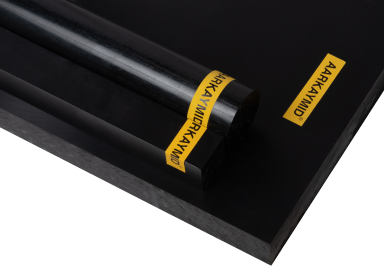 | POM Black POM material, commonly called Acetal or Polyacetal is a remarkable material known for its properties of providing high strength and stiffness,... View product → |
Frequently asked questions
Why does POM Black suit low-friction machine components?
POM Black offers dry-sliding behaviour, low moisture uptake and stable running clearances, which can reduce drag, stick-slip and noise in suitable assemblies.
What must you check before using POM Black in a machine part?
Match the grade and design to contact load, sliding speed, operating temperature, counterface material, contamination and lubrication conditions.
Does black colour prove that POM has low-friction properties?
No. Black identifies colour, not tribological performance. Request the exact grade and confirm friction, wear, filler and operating-limit data.
How should you specify POM Black to a Bhopal supplier?
State the component geometry, dimensions and tolerances, load, speed, temperature, environment, mating material, lubrication, quantity, grade and required inspection documents.