
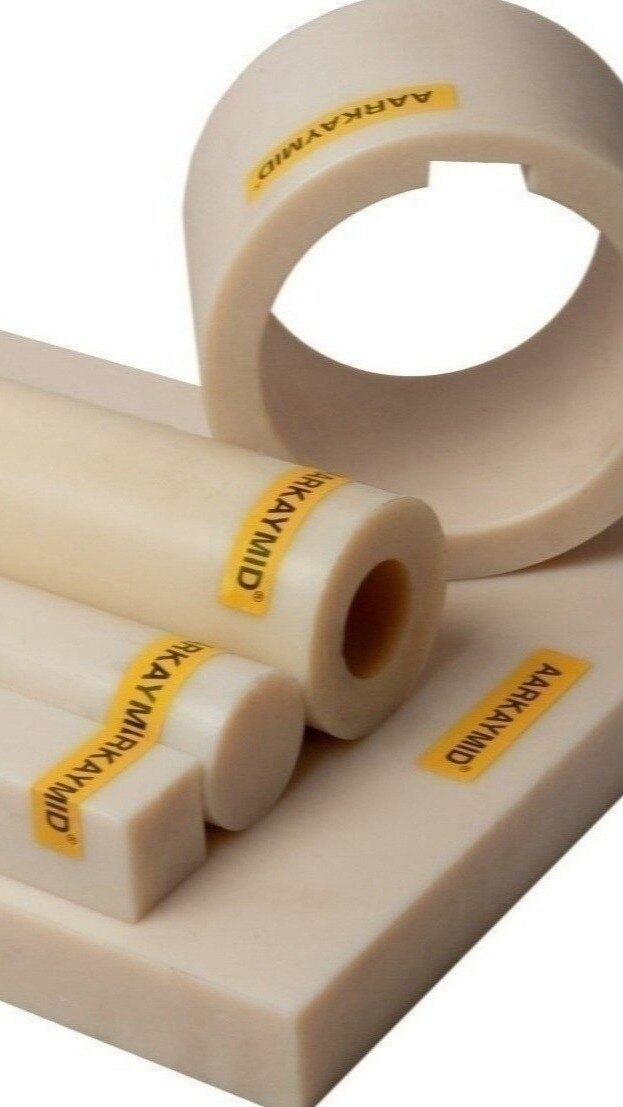
Adding glass fibre to nylon raises stiffness, strength, heat-deflection resistance and creep resistance, but it also changes impact behaviour, moisture response, machining and directional performance. By the end, you will be able to compare reinforced and unfilled tubes, specify the measurements and material data that matter, and decide whether the extra cost earns a measurable design benefit.
Key takeaways
- Specify fibre orientation and grade, not only tube diameter.
- Condition nylon before finalising fit and machining tolerances.
- Check chemical exposure, temperature and wear together.
- Request resin grade, glass content and batch traceability.
What glass fibre changes in a nylon tube
A glass filled nylon tube raises tensile modulus, tensile strength, heat-deflection resistance and resistance to long-term deformation. These glass filled nylon benefits help when a tube must carry load, resist creep or retain dimensions at temperature, but the added fibres reduce elongation at break and often reduce impact toughness and ductility.
| Option | Main advantage | Choose it when |
|---|---|---|
| Glass filled nylon tube | High stiffness, load capacity, creep control and dimensional retention | The design is limited by deflection, sustained stress or heat |
| Unfilled cast nylon tube | Better impact absorption, toughness, lower friction and simpler machining | The tube must tolerate shock, slide easily or keep material and machining costs down |
| Unfilled extruded nylon tube | Tough, workable and economical for less demanding loads | Stiffness and long-term dimensional stability are not the limiting requirements |
A glass filled engineering plastic is not one material specification. Ask for the PA6 or PA66 matrix, glass percentage by weight, fibre form or length, stabilisers, manufacturing process and test condition; these variables change strength, expansion, wear and machinability.
Choose reinforcement when an unfilled cast or extruded nylon tube bends excessively, creeps under a clamp or loses its fit with temperature. Retain unfilled nylon when impact absorption, easy machining, lower cost, low friction or ductility matters more. Glass fibre reduces creep; it does not eliminate long-term deformation.
Check sustained load against temperature, moisture, wall stress and time rather than using short-term tensile strength alone.
Why tube properties vary around the circumference
A glass reinforced polyamide tube has a nylon matrix containing short glass fibres distributed through the wall. During extrusion, melt flow tends to align those fibres along the tube length, so the axial direction can differ sharply from the hoop direction around the circumference. One tensile value cannot describe both.
That anisotropy changes the failure risk by load type. Axial fibre alignment can help resist pull-out and longitudinal bending, while hoop strength governs expansion from internal pressure; clamp loads can create both local crushing and circumferential tension. A tube that passes an axial tensile test can still split lengthwise under pressure.
Internal pressure produces hoop stress and longitudinal stress. Do not substitute axial tensile strength for hoop data. Wall-thickness variation, fibre orientation, weld lines from the extrusion tooling, end constraints and local defects can control failure even when a room-temperature datasheet appears adequate.
Before approving an engineering plastic tube for glass filled nylon, request:
- Tensile strength and modulus in axial and hoop directions
- Minimum and measured wall thickness, plus allowable variation
- Weld-line location, strength and inspection method
- Burst-pressure results at the operating temperature
- Long-term pressure or creep-test evidence at the intended pressure, temperature and moisture condition
Use bending, clamp and pull-out loads to assess local geometry, not just the nominal material grade. For pressure service, the glass reinforced polyamide tube needs directional evidence that matches the actual restraint and loading.
How to specify dimensions and moisture-conditioned fit
Approve a glass filled nylon tube against measured dimensions, not nominal diameter alone. The glass filled nylon benefits include dimensional retention, but moisture and directional expansion can still upset a bore, press fit or seal.
1. Put these values on the drawing: outside diameter, inside diameter, wall thickness, cut length and length tolerance, roundness, concentricity and machining allowance. Inspect the bore and outside diameter at several clock positions; a correct average can hide a locally thin wall or oval bore.
2. State the dimensional condition beside every critical size: dry-as-molded, conditioned or equilibrium moisture. PA6 and PA66 absorb atmospheric moisture; conditioning generally increases ductility and impact resistance while reducing stiffness, strength and electrical insulation performance. Measure a press-fit bore after the specified conditioning, not only straight from production.
3. Check stability using the actual wall stress, load duration, operating temperature and moisture condition. Compare those inputs with the grade manufacturer’s creep or stress-relaxation data; short-term tensile strength cannot predict a months-long interference load. Reject the design if the predicted deformation consumes the fit, seal compression or machining allowance.
Calculate differential expansion against the metal shaft, housing or fitting across the full temperature range. Use the grade’s directional coefficient of thermal expansion, because axial and hoop values can differ with glass-fibre orientation. A metal-restrained tube can gain interference when the polymer expands more, or lose sealing pressure when it expands less.
Temperature, chemicals and wear: where reinforcement earns its cost
A higher heat-deflection temperature does not establish a universal continuous-use temperature for a glass filled nylon tube. HDT comes from a specified load and test method; verify the exact grade’s continuous-service guidance against creep, oxidation, moisture, chemical exposure and the stress applied in your design.
Glass filled nylon benefits are strongest where stiffness, load capacity, creep control or dimensional retention limits an unfilled tube. Treat “glass filled engineering plastic” as a starting label, not a specification: check the matrix and environment before approving it.
- Confirm whether the matrix is PA6 or PA66, then check that grade’s compatibility with acids, oxidising agents and solvents. Glass fibre does not make the nylon matrix universally chemical-resistant; temperature, concentration, exposure time and moisture can change the result.
- Evaluate wear under the actual load, speed, temperature and counterface material. Reinforcement can improve wear resistance in loaded sliding, but exposed fibres can abrade a metal shaft or softer polymer and leave a rougher mating surface.
- Reject the reinforced tube when severe impact, transparent inspection, very low friction or simple low-wear machining matters more than stiffness and dimensional stability. Lower ductility and impact toughness can turn a shock load into cracking, while fibre-filled material can complicate finishing.
- Request wear testing against the actual mating material rather than selecting from tensile data alone. A bearing tube is a tribological pair, not an isolated datasheet value.
How to buy and machine the exact grade
Buy by documented grade, not by the phrase “glass filled nylon.” For an engineering plastic tube for glass filled nylon, your supplier brief should identify:
- Exact grade designation and PA6 or PA66 base.
- Glass loading by weight percentage, plus fibre length or form.
- Manufacturing route, such as extrusion or casting, and supplied moisture condition.
- Directional tensile and creep data, coefficient of thermal expansion, thermal limits and chemical-compatibility data.
- Tube dimensions, tolerances and allowable machining allowance.
A glass reinforced polyamide tube consumes cutting edges faster than unfilled nylon because the fibres are abrasive. Machine it with sharp carbide tools, controlled cutting conditions and effective chip evacuation; leave allowance for spring-back rather than machining directly to the final dimension.
Inspect the bore and outside diameter after machining. Exposed fibres can change surface finish, damage a mating surface and make the measured size differ from the supplied tube.
6. Prototype the actual part under its service load, temperature and humidity. Add pressure testing for pressure service and creep or stress-relaxation testing where sustained load matters.
Classic Polymers & Resins can help match tube dimensions and grade documentation to the application, instead of treating “glass filled nylon” as a complete specification. Require the final drawing and purchase record to repeat the selected grade, moisture condition and test basis.
Related product
 | Polyamide Glass Filled Cast Polyamide 6 (Cast Nylon 6 or PA 6) is one of the most versatile thermoplastics. View product → |
Frequently asked questions
What does glass fibre change in a nylon tube?
Glass fibre increases tensile modulus, strength, heat-deflection resistance and creep resistance, but reduces elongation and can reduce impact toughness.
Why can a glass filled nylon tube vary around its circumference?
Flow during extrusion or moulding can orient fibres unevenly, creating directional strength, shrinkage and dimensional differences around the tube.
How should you specify a glass filled nylon tube for accurate fit?
State inside diameter, outside diameter, wall thickness, length, tolerances, grade and moisture condition; verify dimensions after conditioning.
When does reinforcement justify the cost of a nylon tube?
Choose reinforcement when load, creep, heat, dimensional stability or wear resistance outweigh the costs of lower ductility and more difficult machining.